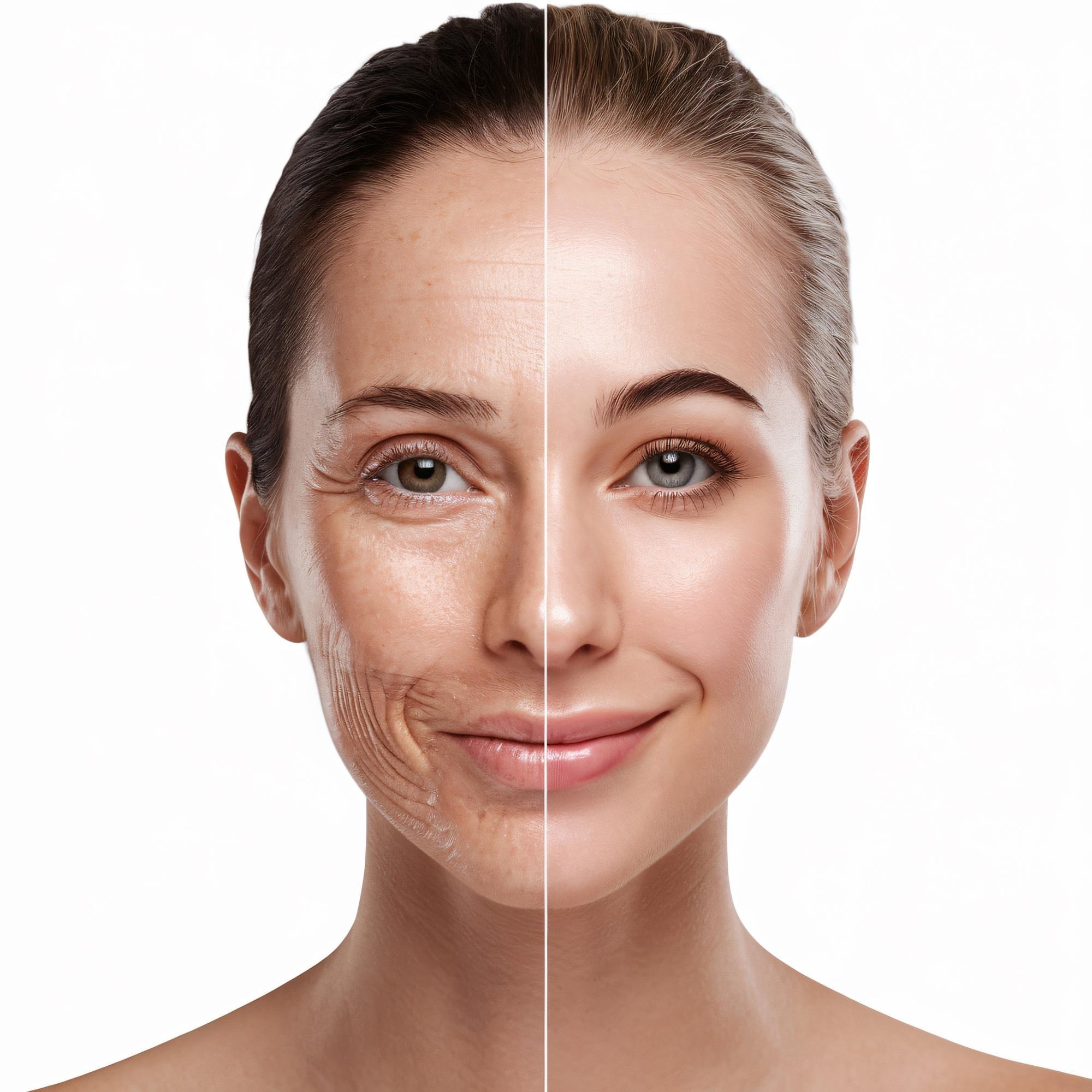
Fine lines, movement-related creases, hollow cheeks, uneven pigment and loose skin arise from different changes, so one treatment cannot correct every concern. By the end, you will be able to match each problem with realistic options, compare downtime and maintenance, and prepare for a safer consultation.
Key takeaways
- Use sunscreen and a retinoid before considering invasive treatment.
- Choose treatment based on movement lines, surface texture, volume loss or loose skin.
- Expect repeated sessions for resurfacing and collagen stimulation.
- Ask about risks, downtime, product details and realistic results at consultation.
Start by identifying the change you want to correct
Dynamic wrinkles appear when muscles contract: frown lines between the eyebrows, forehead lines and crow’s-feet. Static wrinkles remain visible at rest after repeated movement and sun damage, while fine lines often reflect early photodamage, dryness and collagen loss. Sagging skin and jowling indicate tissue descent or laxity, not simply a surface wrinkle.
| Sign you want to correct | What is driving it | Treatment direction |
|---|---|---|
| Dynamic wrinkles | Repeated muscle contraction | Botulinum toxin |
| Static wrinkles and fine lines | Photodamage, collagen loss and etched skin | Sunscreen, retinoids, peels or resurfacing |
| Hollow cheeks or temples | Lost facial volume | Dermal fillers or other volume-restoring options |
| Brown spots or rough texture | Pigment and surface damage | Peels, fractional laser or other resurfacing |
| Sagging skin and jowling | Loose tissue and excess skin | Energy tightening for mild laxity; surgery for substantial laxity |
A laxity assessment determines whether the issue is mild looseness, displaced tissue or redundant skin. Energy devices cannot reliably lift extensive loose skin, and fillers cannot replace a facelift; adding volume to a lax face can create heaviness. Conversely, treating hollowing with botulinum toxin or treating a muscle-driven line with resurfacing misses the cause.
Choose the treatment that matches the anatomy first, then consider combinations for separate problems.
Daily sunscreen, retinoids and injectables: the options for lines and lost volume
Broad-spectrum SPF 30 is the foundation for fine lines caused by ultraviolet damage. Apply it every morning to exposed skin, then add a retinoid for gradual improvement in texture and shallow wrinkles. Prescription tretinoin has the strongest evidence; introduce it slowly because dryness and irritation are common.
Retinol is gentler but less predictable because product strength and stability vary.
| Option | Best match | What it cannot do |
|---|---|---|
| Sunscreen and retinoids | Fine lines, rough texture and early etched-in wrinkles | They improve photoageing over roughly 3–6 months but do not restore hollow cheeks or remove substantial loose skin. |
| Botulinum toxin for dynamic wrinkles | Forehead lines, frown lines and crow’s-feet that appear with muscle movement | It does not replace volume or erase fixed, etched-in wrinkles. Results emerge within several days; a Botox timeline of 3–4 months after injection is a realistic maintenance expectation. |
| Dermal fillers | Facial hollowing, lost cheek or lip volume, and selected deep folds | They do not tighten extensive lax skin or equal a facelift. Swelling, bruising and lumps can occur. |
| Combined treatment | A face with both movement lines and volume loss | Treating hollowing with toxin creates a category error; poor toxin placement can cause temporary eyelid or brow drooping. |
For etched-in wrinkles visible at rest, tretinoin can soften the lines, while resurfacing treatments may address deeper texture. Fillers suit a fold caused partly by structural volume loss, not every fine surface crease. Choose an experienced medical injector: accidental vascular injection can cause skin injury, visual loss or stroke.
Resurfacing and collagen-stimulating treatments: what effort and results to expect
The trade-off is straightforward: surface treatments improve texture and pigment more reliably than laxity, while energy devices offer modest tightening without removing excess skin. Results also depend on skin tone, acne or infection risk, operator skill and the number of treatments you can accommodate.
| Option | Best match | Effort, results and limitations |
|---|---|---|
| Microneedling | Rough texture, enlarged pores and fine lines | A course of microneedling sessions is usually needed; downtime is commonly brief. It stimulates collagen but has limited effect on pigment or sagging. |
| Chemical peels | Dullness, uneven pigment and fine surface lines | Ask about chemical peel depth, concentration and pH. Superficial glycolic, lactic or salicylic peels need repeated treatments; deeper peels improve wrinkles more but bring longer downtime and greater risks of pigment change or scarring. |
| Fractional laser resurfacing | Texture, dyschromia and fine wrinkles | Fractional laser resurfacing treats columns of skin. Ablative treatment gives stronger resurfacing with more downtime and higher risks of prolonged redness, infection, milia, scarring and post-inflammatory hyperpigmentation than non-ablative treatment. |
| Non-ablative radiofrequency | Mild laxity and skin firmness | Non-ablative radiofrequency skin tightening sessions produce gradual, variable tightening. Excessive heating can cause burns, fat loss or contour irregularity. |
| Microfocused ultrasound | Mild-to-moderate laxity | It creates deeper thermal injury and gradual, modest tightening. It cannot remove loose skin; pain, swelling, numbness and rare nerve injury are possible. |
Choose a peel or laser for a surface problem, not a facelift substitute. If etched lines remain at rest or laxity is substantial, these treatments can soften appearance but will not recreate lost volume or remove excess skin.
Threads and surgery: choosing between modest lifting and excess-skin removal
Consider threads for mild sagging when you want a modest, temporary lift and have little excess skin. They cannot remove folds of loose tissue, reposition deeper structures like a facelift, or correct hollowing that needs carefully placed filler.
For a thread lift, PDO, PLLA and PCL comparison matters because materials, anchoring designs, durability and approved uses differ by product and country. Ask which specific thread is being used, how long its lifting effect is expected to last, and what happens if dimpling, asymmetry, infection or a visible thread develops.
| Option | What it addresses | When it applies |
|---|---|---|
| Thread lift | Mild jowling or brow descent | You accept a subtle result, recovery, and possible repeat treatment |
| Facelift | Jowls, lower-face laxity and substantial excess skin | Loose skin and deeper tissue displacement are the main problem |
| Neck lift | Neck bands, a heavy neck contour and hanging skin | Laxity is concentrated below the jaw or under the chin |
| Surface or injectable treatment | Texture, pigment, muscle lines or volume loss | Skin quality, wrinkles or hollowing—not major skin excess—is the priority |
A facelift or neck lift physically repositions and removes tissue, so it usually provides the strongest correction for marked laxity. Surgical lifting versus non-surgical skin tightening involves a clear trade-off: surgery brings greater change and scars, downtime, bleeding, infection and nerve-injury risks; energy devices and threads involve less recovery but cannot remove excess skin.
How to compare treatments safely at a consultation
A safe recommendation starts by matching the treatment to anatomy, not choosing the newest device. Examine skin type and pigmentation risk, laxity pattern, facial volume, muscle activity, static lines, scars, active acne and infection. Review medications and previous procedures, including isotretinoin, blood thinners, fillers, threads, lasers and surgery, because they affect healing and complication risk.
At Welcome to Advanced Skin & Hair Laser, use the consultation to ask whether the device and settings suit these findings.
| Option | Consultation focus | Main trade-off to clarify |
|---|---|---|
| Botulinum toxin | Dynamic lines caused by muscle activity | Effects emerge over several days and last about 3–4 months; poor placement can cause drooping or asymmetry |
| Filler | Volume loss, selected folds or contour changes | Swelling and bruising are common; ask about the plan for rare vascular injection |
| Laser, peel or microneedling | Texture, fine lines and pigmentation | Compare downtime and post-inflammatory hyperpigmentation risk |
| Radiofrequency or ultrasound | Mild laxity | Tightening is modest and variable; excessive heating can cause burns or fat loss |
| Surgery | Major excess skin | Discuss anaesthesia, scars and recovery time |
Ask these questions before booking:
- Which anatomical problem are you treating, and what result is realistic by what date?
- What are the common side effects, rare emergencies and exact response plan?
- How much redness, swelling, bruising or peeling should I schedule around?
- Which medications or skincare products must I stop, and when?
- How many sessions are needed, when is maintenance due, and what happens if the result is uneven?
Related services
Anti-Ageing Procedures Treatment Anti-Ageing Procedures Treatment Ageing is a natural process, but with advanced dermatological treatments, you can maintain youthful, radiant skin for longer. View service → |
Aesthetic Procedures Treatment Aesthetic Procedures Treatment Aesthetic procedures are advanced non-surgical treatments designed to improve skin health, enhance facial features, and restore a youthful... View service → |
Frequently asked questions
How do dynamic and static wrinkles differ?
Dynamic wrinkles appear during muscle movement, while static wrinkles remain visible at rest after repeated movement, sun damage and collagen loss.
Which treatments address sagging skin and jowling?
Threads offer modest lifting, while surgery removes excess skin and provides a more substantial correction for significant laxity.
What should you compare before choosing an anti-ageing treatment?
Compare the target concern, expected result, downtime, side effects, number of sessions, maintenance needs and the clinician’s treatment plan.
Do resurfacing and collagen-stimulating treatments give immediate results?
They require recovery and patience because texture and collagen changes develop over time, with repeated sessions needed for some concerns.
Related services
Filter for Facial Rejuvanation Filter for Facial Rejuvanation Facial rejuvenation is a combination of cosmetic treatments designed to improve skin texture, tone, and elasticity, reducing wrinkles, pigmentation. View service → |
Micronedling Micronedling Microneedling is a minimally invasive cosmetic procedure that enhances skin texture, reduces fine lines, and promotes natural collagen production. |
Non-Ablative RF (Skin Tightening) Non-Ablative RF (Skin Tightening) Non-Ablative RF (Radiofrequency) Skin Tightening is a cutting-edge treatment that delivers controlled radiofrequency energy deep into the skin. View service → |
Micro-needling Micro-needling is a cosmetic procedure that involves a device with tiny, sterile needles that create micro-injuries in the skin. View service → |