Thick, sharply defined plaques, silvery scale, itching, cracking, and bleeding need a different approach from ordinary dry skin or eczema. You will learn how to identify patterns, build a skin-care routine, use topical treatments safely, and recognise when recurring disease needs phototherapy, systemic treatment, or assessment for psoriatic arthritis.
Key takeaways
- Plaques with silvery scale on elbows or knees point toward psoriasis.
- Apply fragrance-free moisturiser after bathing to reduce cracking and scale.
- Use different topical medicines cautiously on the face, folds, scalp, and body.
- Seek review when flare-ups spread, resist treatment, or affect joints.
How can you tell psoriasis from other scaly skin conditions?
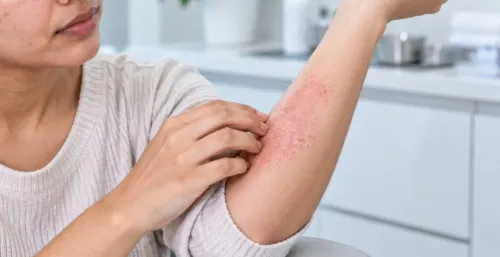
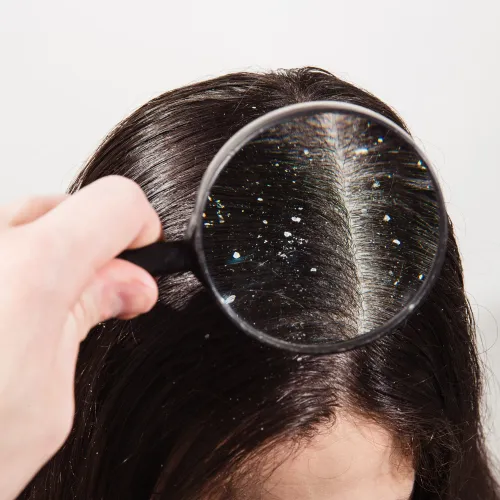
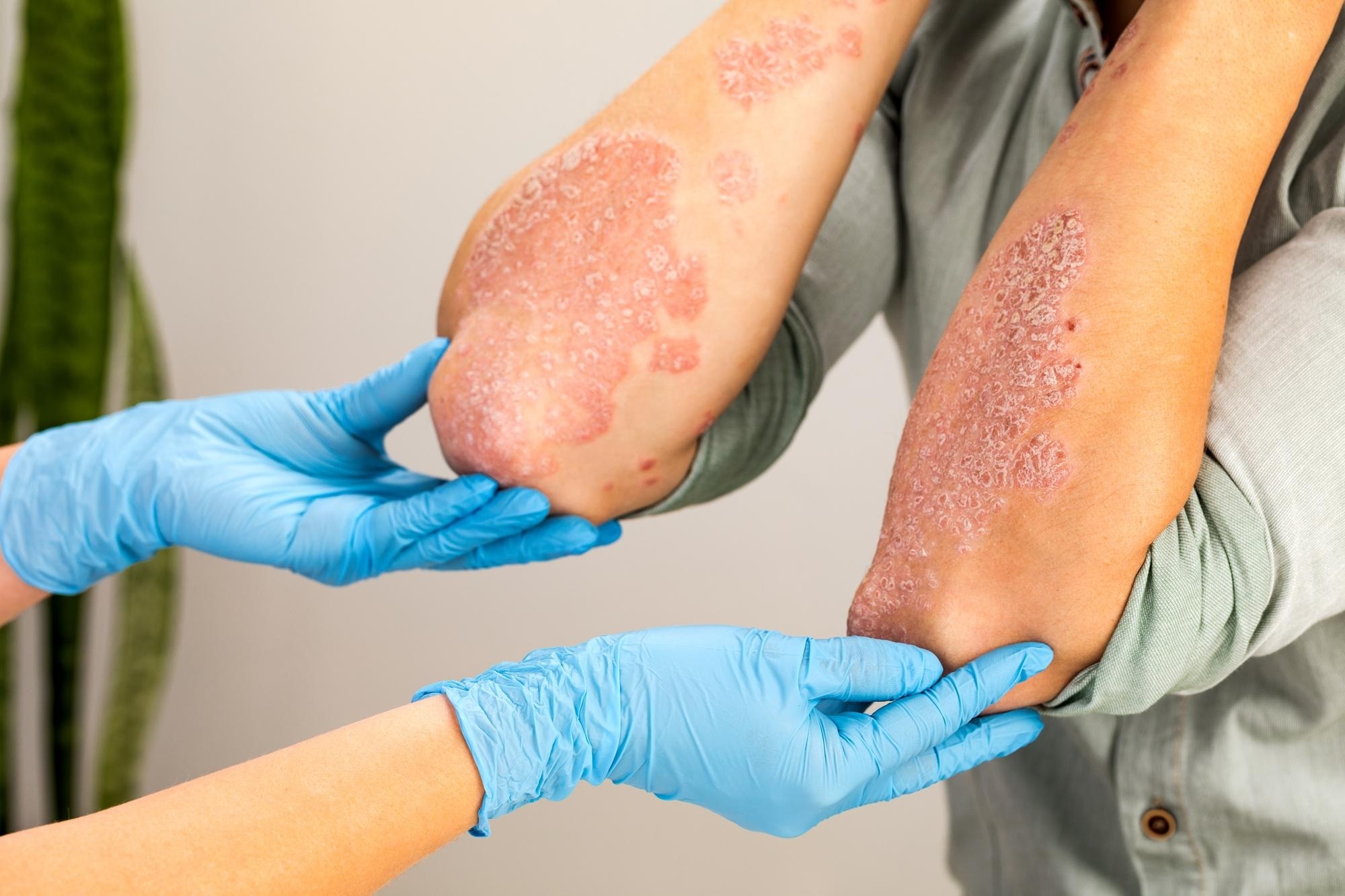
Psoriasis symptoms follow recognisable patterns. Plaque psoriasis forms sharply defined, raised red plaques with silvery scale, commonly on elbows and knees; scratching can crack and bleed. Scalp psoriasis produces thick scale that can extend beyond the hairline. Inverse psoriasis in skin folds is smooth, shiny, and red rather than heavily scaly.
Guttate psoriasis causes many small, drop-shaped spots, often after a throat infection. Nail psoriasis causes pits, ridges, crumbling, or separation from the nail bed.
| Pattern | Psoriasis clue | Common alternative |
|---|---|---|
| Plaques | Thick, sharply bordered, silvery scale | Eczema is usually less sharply outlined and intensely itchy |
| Scalp | Thick scale beyond the hairline | Seborrhoeic dermatitis has finer, greasy yellow scale around the scalp, eyebrows, or nose |
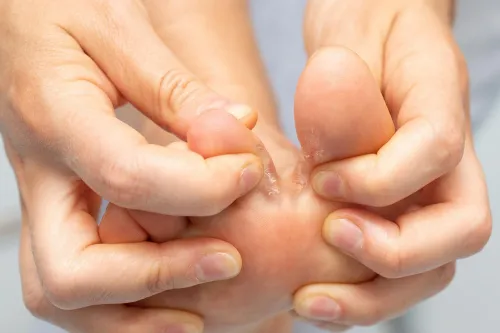
| Folds | Smooth, sore red patches | Fungal infection often has a ring-like advancing edge; moisture can worsen it |
| Small spots | Guttate lesions appear suddenly across the trunk or limbs | Contact dermatitis stays where an allergen or irritant touched |
| Nails | Pits, lifting, or crumbling | Simple dry skin causes fine scaling without plaques or nail changes |
Fungal infection can spread outward and needs antifungal treatment, while simple dry skin causes diffuse tightness and fine flakes that improve with moisturiser. Diagnosis must come first: a corticosteroid can disguise or worsen fungal infection, while antifungal treatment will not control psoriasis.
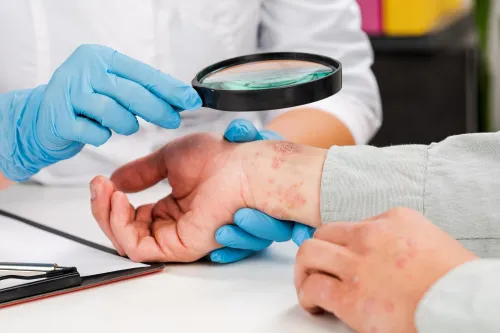
A clinician may inspect the nails and scalp, examine distribution, and scrape scale for a fungal test before choosing treatment.
What daily routine reduces scale, cracking, and irritation?
Apply a psoriasis moisturiser within three minutes of bathing, while your skin is still slightly damp. This daily dry scaly skin treatment reduces water loss, tightness, cracking, and itch, but it does not control psoriasis inflammation or prevent every flare.
- Take a short bath or shower with lukewarm water. Hot water strips oil and can intensify irritation.
- Clean only sweaty or dirty areas with a gentle, fragrance-free cleanser. Do not scrub, brush, or pick scales; cracks and bleeding invite further irritation.
- Pat dry, then cover plaques with cream or ointment within three minutes. Reapply after handwashing and whenever skin feels tight.
Choose the texture according to the area and the type of scale:
| Option | Best use | Important caution |
|---|---|---|
| Petrolatum ointment | The driest, most cracked plaques; strongest water barrier | Greasy and uncomfortable under clothing or in skin folds |
| Thick cream | Everyday body use when you need moisture without heavy grease | Less occlusive than petrolatum, so reapply when tightness returns |
| Lotion | Hair-bearing areas or daytime use | More water, less barrier protection; often inadequate for thick plaques |
| Urea cream for psoriasis | Rough, thick scale that needs softening | Can sting fissures, especially at higher strengths |
| Lactic acid product | Mild roughness when the skin surface is intact | Can burn inflamed, scratched, or cracked skin |
Urea and lactic acid are keratolytics, not anti-inflammatory medicines. Stop them on open fissures, raw skin, or severe burning; use plain petrolatum instead and seek advice before applying keratolytics over large areas.
How should topical psoriasis medicines be used on different body sites?
Use plaque thickness and body site to choose topical psoriasis treatment. Apply a thin, even layer to the plaque, not a thick coating over surrounding skin. A thick elbow or knee plaque may need a short course of a potent psoriasis steroid cream; thinner plaques usually need a lower-potency steroid or a non-steroid option.
| Treatment | Best fit | Important limit |
|---|---|---|
| Corticosteroid | Thick, inflamed plaques; potency matches site | Potent steroids need short courses; prolonged use can thin skin |
| Calcipotriol or another vitamin D analogue | Plaques and maintenance after inflammation settles | Can irritate sensitive skin and is not a substitute for supervision |
| Steroid plus calcipotriol | Many body-site plaques needing stronger control | Use the prescribed duration and schedule |
| Coal tar | Thick, scaly plaques or scalp disease | Smell, staining, and irritation can limit use |
| Salicylic acid | Heavy scale that blocks medicine | It softens scale but does not treat inflammation; avoid extensive use on broken skin |
Face, eyelids, folds, and genitals need low-potency steroids for limited periods or non-steroid medicines because potent steroids increase skin-thinning risk. Calcipotriol can sting these areas. For scalp psoriasis treatment, choose a solution, foam, gel, oil, or medicated shampoo rather than ordinary cream; soften scale first, then let the medicine reach the scalp.
Do not scrape or pick forcefully. Trauma can trigger new plaques through the Koebner phenomenon. After control, frequent relapsers may use prescribed treatment once or twice weekly, but the interval depends on steroid potency and location.
When are phototherapy or systemic treatments appropriate?
Narrowband UVB psoriasis treatment is medical phototherapy for widespread or treatment-resistant plaques, usually delivered two or three times weekly with prescribed dose increases. A 308 nm excimer laser is targeted UVB for selected, stubborn localized plaques; it does not treat widespread disease or the underlying tendency to flare.
Neither treatment is a cosmetic laser. Cosmetic lasers resurface or alter tissue for appearance, while psoriasis phototherapy uses controlled ultraviolet exposure for inflammation. Sunbeds are not a substitute: their exposure is uncontrolled and adds photoaging and skin-cancer risk.
The decision to escalate treatment depends on impact, not skin area alone:
- Consider hands or feet disabling even when the affected area is small, because cracking can impair walking, gripping, or manual work.
- Count itch, bleeding, sleep disruption, missed work, and quality-of-life loss.
- Treat nail disease as a separate burden; thickened, lifting, or painful nails can justify escalation.
- Review failure of appropriate topical treatment and relevant phototherapy, not just the number of plaques.
NICE-style decisions often consider systemic psoriasis treatment when psoriasis remains severe or substantially affects quality of life, such as a PASI of 10 or more with a DLQI above 10 despite standard care. Biologics and other systemic medicines require infection screening, blood monitoring, and individual risk assessment.
They are treatment for inflammatory disease, not stronger moisturisers or cosmetic procedures.
How can you reduce recurring flare-ups and know when to seek review?
Use a written flare plan based on your prescribed psoriasis maintenance treatment, including intermittent treatment on previously affected areas when your clinician advises it. This approach supports psoriasis flare-up prevention; moisturiser alone eases cracking and itch but does not control the underlying inflammation.
Arrange a treatment review when any of these possible triggers appear:
- A new or recently worsening infection
- Sustained stress, smoking, or heavy alcohol use
- Scratching, burns, cuts, tattoos, friction, or other skin trauma, which can cause the Koebner phenomenon
- A new medicine or dose change involving lithium, a beta-blocker, or an antimalarial
Do not stop a suspected medicine abruptly. Ask the prescriber to assess the risk and discuss a safer alternative or adjustment.
Seek prompt assessment for possible psoriatic arthritis symptoms, especially if you develop:
- Persistent joint pain or swelling
- A whole swollen finger or toe
- Heel pain
- Morning stiffness that lasts longer than usual or continues for weeks
Joint disease can progress even when the skin plaques seem limited, so do not wait for a major skin flare.
At Welcome to Advanced Skin & Hair Laser, a dermatology assessment can match the plan to the affected body site, symptoms, and your previous response to treatment. That prevents every recurrence from being treated as simple dryness and helps identify when a different topical, phototherapy, or specialist review is needed.
Frequently asked questions
How can you tell psoriasis from other scaly skin conditions?
Psoriasis often forms sharply defined, raised plaques with silvery scale on the elbows and knees. Scalp psoriasis can extend beyond the hairline, while inverse psoriasis is smooth, shiny, and red in skin folds.
What daily routine reduces scale, cracking, and irritation?
Use short lukewarm baths or showers, a gentle fragrance-free cleanser, and a thick moisturiser immediately afterward. Avoid scrubbing, picking scale, and fragranced products.
How should topical psoriasis medicines be used on different body sites?
Follow the prescribed amount and instructions, because steroid strength and application limits differ for the body, face, skin folds, and scalp. Keep medicine away from the eyes and broken skin unless instructed.
When are phototherapy or systemic treatments appropriate?
A dermatologist can consider phototherapy or systemic treatment when psoriasis is extensive, repeatedly flares, affects difficult sites, or does not respond adequately to topical medicines.
How can you reduce recurring flare-ups and know when to seek review?
Track triggers, moisturise regularly, avoid skin injury, and use prescribed treatment during early symptoms. Arrange review when lesions spread, fail to improve, or cause joint pain, swelling, or morning stiffness.